
Your Feelings Are Telling You Something
Many of us find ourselves moving away from our emotions. We distract ourselves, stay busy, push feelings down, criticise ourselves for having them or try to think our way out of them. Some emotions may feel too uncomfortable, overwhelming or inconvenient to face. Others may once have felt unsafe to express at all.
Over time, we can become disconnected from our emotional world — experiencing emotions as problems to avoid rather than experiences to listen to.
Yet emotions are not random or meaningless. They are part of how we respond to the world around us and within us. They can give us information about our needs, boundaries, relationships, values and wellbeing. Our emotions are forms of communication, signals from within ourselves that ask for our attention.
When we ignore or suppress emotions for long periods, they do not necessarily disappear. Often, they remain within us, showing up instead through tension, anxiety, irritability, numbness, exhaustion or a growing sense of disconnection from ourselves.
Sometimes, rather than asking “How do I stop feeling this?”, it can help to ask:
“What might this feeling be trying to tell me?”
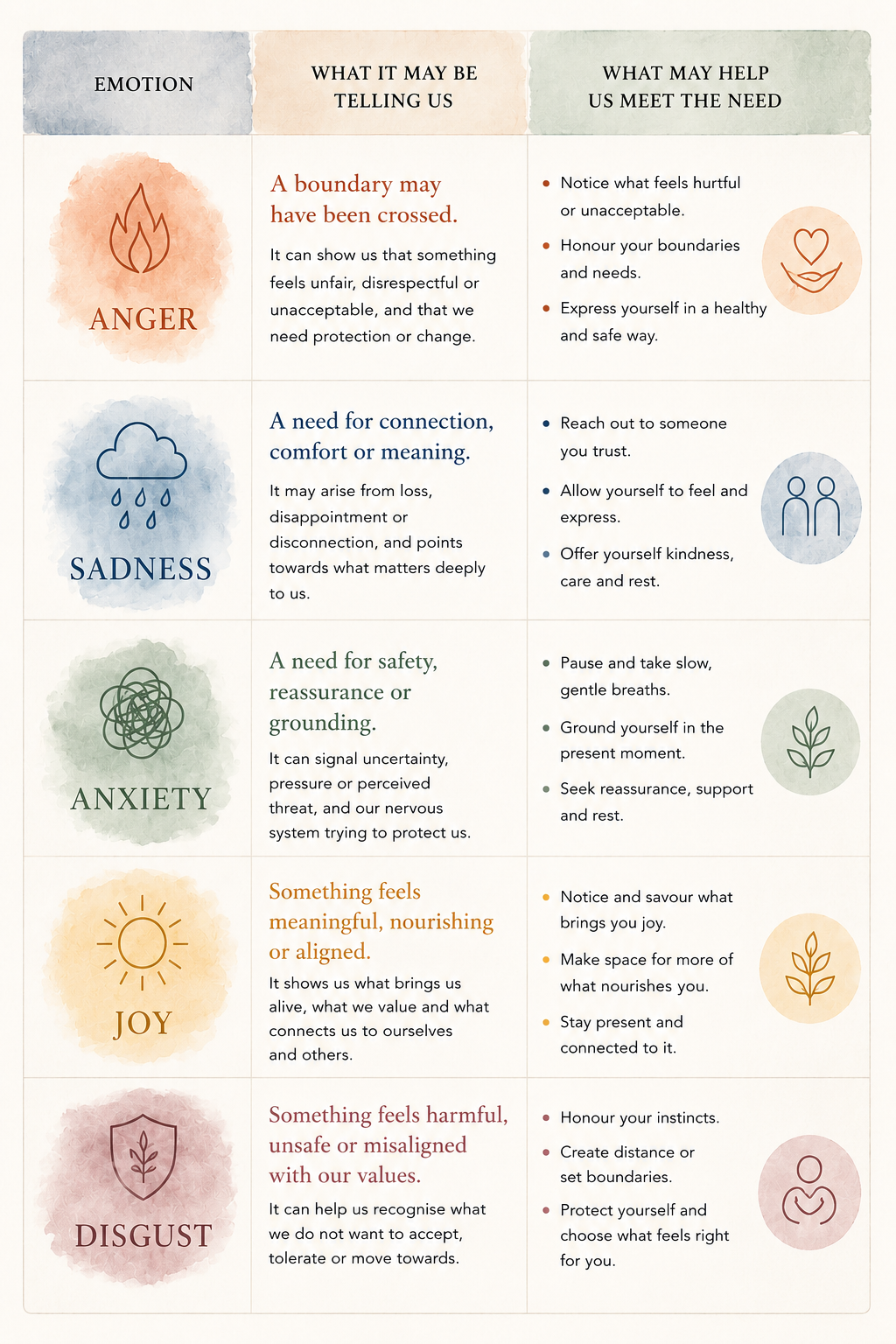
Listening To Our Emotions
To listen to our emotions means to develop a more curious and compassionate relationship with our inner world.
This might involve pausing and noticing:
What am I feeling right now?
What might this emotion be responding to?
What could I be needing in this moment?
As is shown in the image, sometimes an emotion may point towards a need for rest, safety, reassurance, boundaries, connection or expression. Other times, it may simply need acknowledgement and space.
Even gently naming what we feel can help create a sense of awareness and connection within ourselves.
Rebuilding Emotional Connection
For many people, learning to notice and stay with emotions takes time. Emotional attentiveness can feel unfamiliar at first.
This process often begins gently by:
slowing down, through deep breathing and grounding
noticing sensations in the body
naming emotions without judgement
becoming curious rather than critical
responding to ourselves with patience and compassion.
Over time, this can help us build a more connected and trusting relationship with ourselves, and help us be guided towards what we need.
Closing Thoughts
Emotions are not interruptions to push away, but parts of ourselves asking to be heard. At times, identifying and understanding what we are feeling can be difficult. Tools such as emotion wheels can help us put words to our emotional experience, and speaking with a therapist may support us in connecting more deeply with our emotions and understanding what they may be communicating.
If you would like to explore this further and better understand your emotional world, please feel free to reach out — I would love to hear from you.